
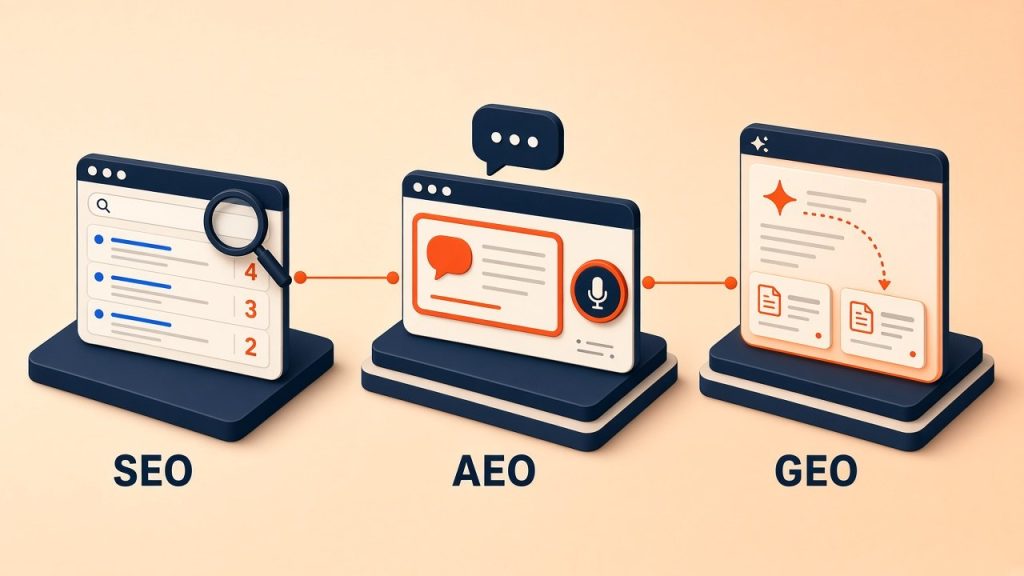
SEO vs AEO vs GEO comes down to where your content appears. SEO (search engine optimization) helps pages rank in the list of search results. AEO (answer engine optimization) helps a page supply the direct answer shown in a featured snippet, a “People also ask” box or a voice assistant reply. GEO (generative engine optimization) helps your brand get mentioned and cited when AI tools such as Google AI Overviews, ChatGPT or Perplexity write an answer. All three rely on the same base: a site that can be crawled, content that answers real questions clearly, and consistent facts about your business.
What is SEO?
Search engine optimization is the work of helping search engines find, understand and rank your pages. Google’s process has three stages: crawling (discovering pages by following links and sitemaps), indexing (storing and understanding what each page is about) and ranking (choosing which indexed pages best answer a query). SEO covers each stage.
- Technical SEO: crawlable site structure, an XML sitemap, correct canonical tags, fast loading and a mobile-friendly layout.
- On-page SEO: page titles, headings and content that match what people are actually searching for.
- Authority: links and mentions from other relevant, trusted websites.
- Local SEO: a complete Google Business Profile, consistent name, address and phone details, and genuine reviews.
The outcome you are working towards is a visit: someone sees your page in the results, clicks, and lands on your site.
What is AEO?
Answer engine optimization focuses on the results where the searcher gets an answer without scrolling through links. That includes featured snippets at the top of Google, expandable “People also ask” questions, knowledge panels, and spoken replies from assistants such as Google Assistant, Siri and Alexa.
These features pull a short passage from a page that already ranks, so AEO is about making that passage easy to lift:
- Phrase headings as the question people ask, for example “How long does SEO take?”
- Answer in the first 40 to 60 words under that heading, then add detail.
- Use numbered steps for processes and short lists for options, since snippets often display lists.
- Add structured data (schema markup) that describes the page type, organization and author.
One detail that is often missed: in 2023 Google limited FAQ rich results to well-known government and health websites and stopped showing How-to rich results. FAQ schema still helps machines read your content, but it no longer produces the expandable FAQ display for most business sites.
What is GEO?
Generative engine optimization is about the answers written by AI. Instead of listing ten links, tools like Google AI Overviews, Google AI Mode, ChatGPT search, Perplexity, Gemini and Microsoft Copilot read several sources and write one combined response, usually with a few cited links. The term came from academic researchers in 2023, and it describes a new goal: being one of the sources the AI draws on and names.
AI answers are assembled from content these systems can retrieve and trust, so GEO depends on:
- Clear entity facts: what your business is, what it offers, where it operates and who runs it, stated the same way on your site, Google Business Profile, social profiles and directories.
- Citable content: specific definitions, figures you can stand behind, named methods and plain explanations that can be quoted accurately.
- Third-party mentions: coverage, reviews and listings on other sites, which AI tools use to confirm what you say about yourself.
- Access for crawlers: search and AI crawlers such as Googlebot, Bingbot, OAI-SearchBot and PerplexityBot must not be blocked in robots.txt if you want to appear in those tools.
Google has said there are no extra requirements to appear in AI Overviews: a page must be indexed and eligible to show a snippet in normal search. That is why GEO starts with sound SEO rather than replacing it.
SEO, AEO and GEO compared side by side
- Where you appear: SEO targets the list of ranked links; AEO targets snippets, answer boxes and voice replies; GEO targets AI-written answers and their cited sources.
- What success looks like: SEO wins a click; AEO wins the quoted answer, sometimes without a click; GEO wins a mention or citation inside the AI response.
- Main signals: SEO relies on relevance, quality, page experience and links; AEO relies on concise, well-structured answers; GEO relies on consistent facts, credible sources and mentions across the web.
- How you measure it: SEO uses rankings, impressions and clicks; AEO uses snippet and “People also ask” ownership; GEO uses brand mentions in AI answers and referral visits from AI tools.
How the three work together
They are layers, not alternatives. SEO gets a page crawled, indexed and ranking. AEO shapes the same page so a clear answer can be extracted from it. GEO extends that clarity beyond your own site, so AI tools find matching facts wherever they look.
A practical example: a dental clinic in Ranchi publishes a page titled “How much does teeth whitening cost in Ranchi?” Good SEO helps it rank for that search. Opening the page with a direct two-sentence answer and a short price-range list makes it a candidate for the featured snippet. Keeping the clinic’s services, prices and address consistent on its Google Business Profile, directories and local news mentions makes it more likely that an AI assistant names the clinic when someone asks for whitening options in the city.
How to measure SEO, AEO and GEO results
- Google Search Console: shows impressions, clicks, average position and indexing problems. Traffic from AI Overviews and AI Mode is counted within the standard web search report rather than shown separately.
- Snippet tracking: most rank-tracking tools report which keywords show a featured snippet and whether your page holds it.
- AI referral traffic: in Google Analytics 4, check referral sources such as chatgpt.com, perplexity.ai, gemini.google.com and copilot.microsoft.com.
- Prompt testing: ask the main AI tools the questions your customers ask, every month, and record whether your brand is mentioned, how it is described and which sources are cited.
- Leads: track calls, forms and WhatsApp enquiries, because visibility only matters if it brings customers.
Where should a business start?
- Fix technical basics: make sure key pages are indexed in Search Console, load quickly on mobile and are not blocked in robots.txt.
- Build one strong page per service and location, written around the questions customers actually ask.
- Open each page with a direct answer, then support it with detail, examples and prices where possible.
- Add Organization, LocalBusiness and Article schema, and keep it accurate.
- Make your business facts identical across your website, Google Business Profile, social profiles and directories.
- Earn genuine mentions through reviews, local press, industry listings and useful content others want to reference.
- Review results monthly in Search Console, Analytics and AI prompt tests, then improve the pages that are close to winning.
Common mistakes to avoid
- Treating GEO as a shortcut that skips SEO; AI tools still rely heavily on pages that search engines can index and trust.
- Writing long introductions before the answer, which makes snippets and AI summaries less likely to use the page.
- Publishing different addresses, phone numbers or service descriptions on different platforms.
- Blocking AI crawlers by accident while copying a robots.txt template.
- Judging success by rankings alone instead of enquiries and sales.
Frequently asked questions
Is GEO replacing SEO?
No. Search engines still send most website traffic, and AI tools draw heavily on indexed web pages. GEO adds a new place to be visible, but it depends on the same crawlable, trustworthy content that SEO builds.
Is AEO the same as GEO?
They overlap but differ. AEO targets fixed answer features such as featured snippets and voice replies, which quote one source. GEO targets AI-written answers that combine several sources, where the aim is to be among the brands mentioned or cited.
How long do SEO, AEO and GEO take to show results?
Technical fixes can show up within weeks once pages are recrawled. Rankings and featured snippets in competitive searches usually take several months. AI mentions often follow later, as consistent information and third-party coverage build up.
Do small local businesses need all three?
Most need the shared foundation rather than three separate projects: a sound website, clear answers to customer questions, a complete Google Business Profile and consistent details everywhere. That foundation supports all three at once.
Next steps
For a deeper side-by-side breakdown, read our SEO vs AEO vs GEO comparison or the guides to search engine optimization, answer engine optimization and generative engine optimization. If you would like help, see our SEO, AEO and GEO services or book a free consultation.